How AI is changing the sales function
AI is reshaping sales in ways that are more nuanced than the pitch decks suggest. Some tasks are genuinely going away. Others are becoming more important.
By Zylver Editorial
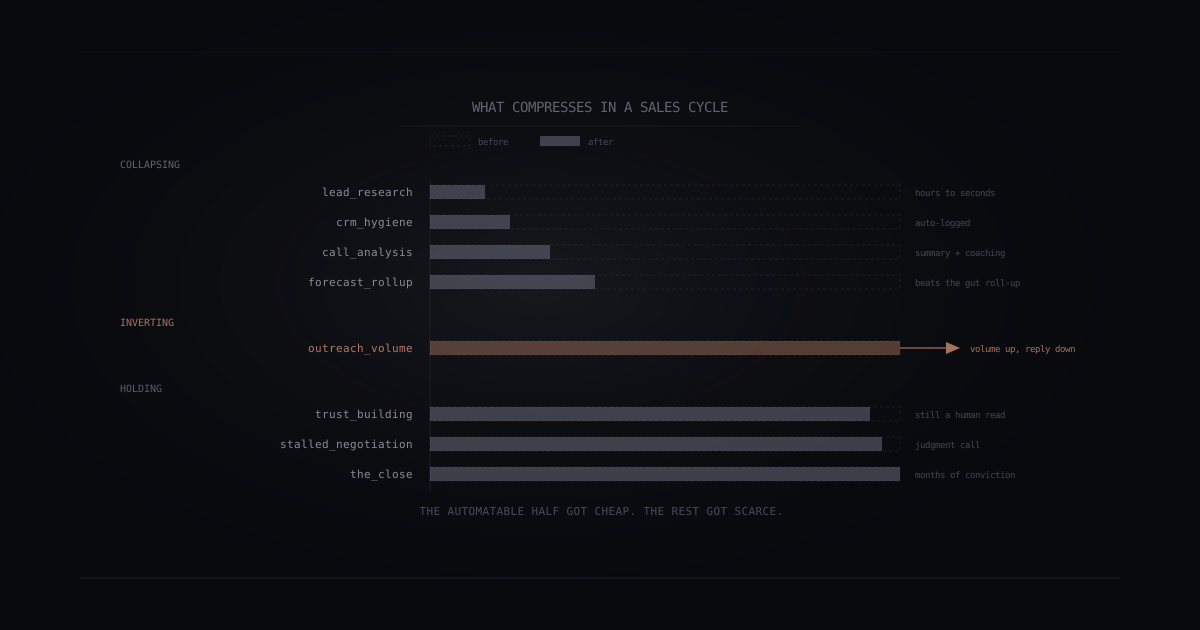
Sales is one of the functions where AI adoption is moving fastest. It is also one of the functions where the gap between what vendors promise and what is actually happening is widest. The reality is more nuanced than either the optimistic pitch or the skeptical backlash would suggest.
Some sales tasks are being automated in ways that are real and durable. Others are proving more resilient than expected. And a few assumptions about what AI would change have turned out to be wrong.
What is actually changing
Lead research and qualification. The time a rep spent manually researching a prospect before a call, reading press releases, checking LinkedIn, noting recent company announcements, is collapsible to near zero. AI tools can synthesize this in seconds. This does not make the research less valuable; it makes it accessible at a scale that was not practical before. Reps who previously skipped prep because it took too long now have no excuse.
Outreach volume. AI-generated cold outreach is producing the predictable result: more of it, and lower quality on average. Inboxes are filling with messages that are technically personalized (they reference the right company, the right role, sometimes a recent news item) but feel templated. Buyers are developing better filters for this, both cognitively and technically. The irony is that the signal value of a genuinely thoughtful, non-AI-sounding message has gone up as the noise floor rises.
Call analysis. Conversation intelligence has been around for several years, but AI has made it significantly more useful. Summarization, objection tracking, next-step extraction, and coaching suggestions from recorded calls are now practical for most sales organizations. The main adoption blocker is not the technology but the organizational will to actually use what the analysis surfaces.
Forecast accuracy. AI-assisted forecasting that incorporates activity signals, deal velocity, and historical patterns is producing more accurate pipeline estimates than intuition-based manager roll-ups. This is one of the cleaner wins. The forecast quality improvement is real, measurable, and hard to dispute.
CRM hygiene. Updating CRM records after every interaction has been a persistent friction point in sales organizations for thirty years. AI tools that auto-log calls, suggest field updates, and populate activity history are reducing this friction meaningfully. This is not glamorous, but it is durable value.
What is not changing
The high-stakes relationship sale does not compress. When a company is evaluating a platform that will affect their operations for years, the human judgment on both sides of the deal matters. The buyer wants to understand how the vendor thinks, not just what they sell. The rep needs to navigate organizational dynamics that no AI has access to.
Trust, particularly in complex sales cycles, is still built through interactions that have a human quality to them: calls where the rep says something candid that is not in the deck, references to shared context from earlier conversations, the willingness to say what is not a good fit. These are hard to replicate not because AI cannot generate similar language but because buyers can sense when they are receiving a performance versus a real conversation.
The closing moment in a large deal is usually not a logical conclusion. It is a series of relationship decisions made by people who have been building conviction over months. AI does not change that dynamic.
Where the leverage actually is
The reps who are using AI well are treating it as a preparation and follow-through tool, not a replacement for the conversation itself. They research better, follow up faster, remember more from previous calls, and write cleaner summaries.
The managers who are using AI well are doing better one-on-ones because they have actual data about what happened on calls rather than what the rep reported. They can coach on specific moments rather than general performance impressions.
The operations teams who are using AI well are surfacing which activities actually correlate with wins in their specific sales motion, rather than relying on industry benchmarks. This turns the CRM from a record-keeping obligation into a source of actual insight.
The quality problem in AI outreach
One pattern worth noting explicitly: the companies using AI to maximize outreach volume are achieving the opposite of what they intend in many cases. Recipients who recognize AI-generated messages (and recognition rates are rising) do not just ignore them; they form a negative impression of the sender. The efficiency gain in top-of-funnel activity is real but comes with a brand cost that is harder to measure.
The companies that will win on outreach are not the ones sending the most messages. They are the ones maintaining enough quality control over what goes out that their messages still get read. In a volume-inflated environment, restraint is a competitive advantage.
What changes for sales leadership
The AI-native sales organization does fewer things on gut. Forecast calls shift from intuition debates to discussing the data. Coaching becomes specific rather than generic. Quota modeling incorporates more variables.
None of this replaces the judgment calls that actually determine performance: which deals to invest time in, how to handle a stalled negotiation, when to escalate. Those remain leadership decisions. What changes is the quality of information those decisions are made from.
For sales leaders, the organizational challenge is not the technology. It is building the habits and accountability structures that make the better data actually matter.
Zylver ships AI products: Forge, Signal, Agents, Flows, and Meter. View all products.
More from Zylver
What to ask before buying an AI platform
Most AI platform evaluations focus on benchmark scores and feature checklists. The questions that predict whether a platform will work in production are different ones.
The hidden cost of context switching in AI workflows
Multi-step AI workflows lose information at every boundary. The handoff between steps is where accuracy degrades, latency compounds, and cost accumulates. Most teams do not measure it.
What separates AI teams that ship from teams that stay in pilot
Most AI pilots succeed. Most AI products don't. The gap isn't technical skill, it's the organizational decisions teams avoid making before the pilot ends.
Get insights like this delivered monthly.
No spam. Unsubscribe anytime.