
Most AI adoption strategy is written at the level of the organization: rollout plans, training budgets, tool selection, executive sponsorship. Almost none of it is written at the level of the manager, even though the manager is where adoption actually happens or does not happen.
A company can have executive buy-in, a generous budget, and a well-chosen tool. It can still see adoption stall in specific teams because the manager was never given a clear role in the process. The manager is not a bystander in AI adoption. They are the primary mechanism by which it succeeds or fails.
Why the manager is the actual lever
Employees do not decide whether to use a new tool based on the company’s stated strategy. They decide based on what their manager visibly does, rewards, and tolerates.
If a manager never uses the tool themselves, their team reads that as permission to skip it too, regardless of what the rollout email said. If a manager praises speed without checking quality, the team learns to prioritize throughput over correctness in ways that create problems later. If a manager treats AI-assisted work as suspect and re-does it themselves “to be safe,” the team draws a conclusion. Using AI does not actually save anyone time, because the manager’s behavior doesn’t change.
This is not a new pattern. It is the same mechanism by which any process change succeeds or fails at the team level. Employees calibrate to what their manager does, not to what the organization says.
What the manager actually needs to do
Use it visibly, not just approve it
A manager who has personally used the tool for real work can answer real questions. That manager can also spot when a team member’s usage is off, and speak with credibility. A manager who has only approved the rollout cannot do any of these things convincingly.
Set explicit quality bars, not implicit ones
“Use your judgment” is not a standard; it is an abdication. Teams need to know specifically:
- What still requires human review
- What the acceptable error rate is for AI-assisted output in their domain
- What a bad outcome looks like, so they can course-correct before it happens
Ambiguity here does not produce careful behavior; it produces inconsistent behavior.
Protect the learning curve
Early AI usage is often slower than the old process, not faster, because people are learning where the tool helps and where it does not. A manager who measures throughput during this period and penalizes the dip is teaching the team to avoid the tool. The learning curve needs an explicit, bounded window where output expectations are relaxed.
Surface failures without punishing them
If the first person to report an AI-generated mistake gets blamed, the team stops reporting mistakes and starts quietly working around the tool. Managers need to treat early failures as expected signal, not as performance problems, particularly in the first few months.
Decide what does not change
Not every task should be AI-assisted. Some contexts do not fit: judgment calls, sensitive communications, anything requiring accountability that cannot be delegated. A manager who pushes AI usage into them creates the kind of bad outcome that poisons trust in the tool for everything else. Part of the manager’s job is drawing that line clearly, not leaving it to individual employees to guess.
The trust dynamic
Employees are, correctly, cautious about tools that could reflect on their judgment or their job security. AI tools sit squarely in that category. Adoption requires trust, and trust is built through specific manager behaviors, not through policy documents.
Picture a manager who says “I don’t fully trust this yet either, here’s what I’m doing to verify it.” That manager builds more genuine adoption than one who declares unconditional confidence in a tool nobody has stress-tested. Calibrated trust, communicated honestly, produces calibrated usage. Manufactured enthusiasm produces either over-reliance or quiet resistance, and both are worse outcomes than honest caution.
What goes wrong without this
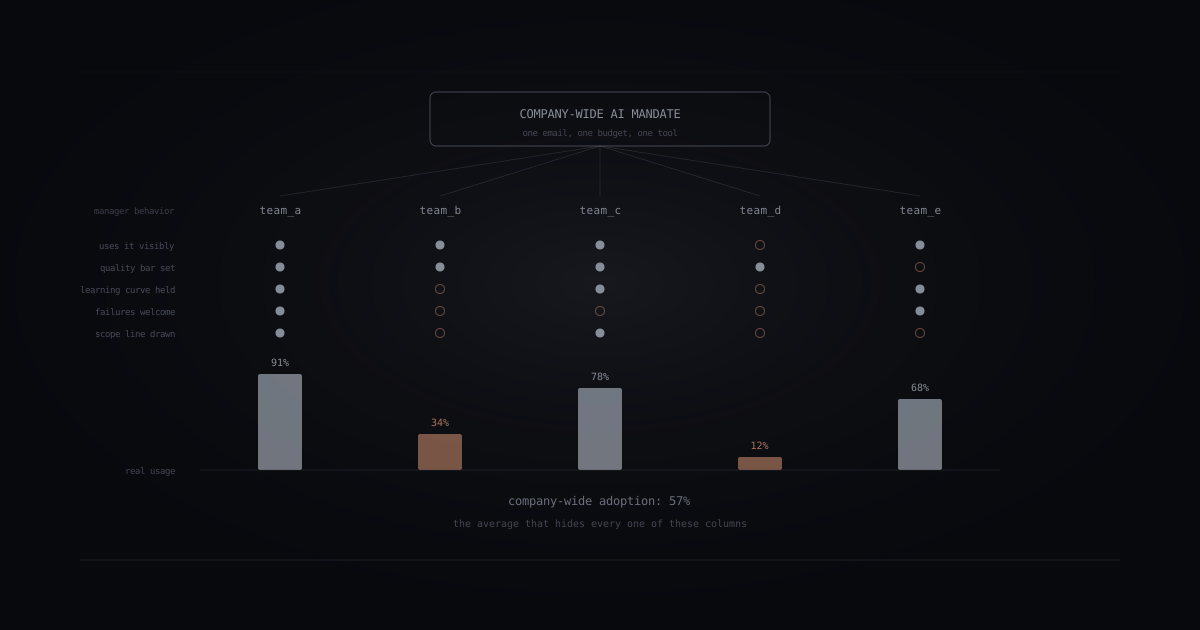
The failure pattern is consistent across organizations: leadership announces an AI initiative, provides training, and expects adoption to follow. Six months later, usage is uneven across teams with no clear pattern related to team function or workload. The pattern that does emerge, when you look closely, tracks manager behavior almost exactly. Teams with managers who used the tool, set standards, and protected the learning curve show strong adoption. Teams with managers who treated the rollout as an HR checkbox show minimal, superficial usage. It looks compliant in a dashboard but produces no actual change in how work gets done.
This is why company-wide adoption metrics can be misleading. Aggregate usage numbers hide enormous team-to-team variance, and that variance is a manager story, not a tool story.
What this means for how companies roll out AI
If the manager is the actual lever, the rollout plan needs to invest disproportionately there. That means manager-specific training that goes beyond “here is how the tool works.” The training should cover how to set expectations, how to handle early mistakes, and how to model usage credibly. It means giving managers explicit permission and cover to slow down output expectations during the learning period. Otherwise they are left to manage that tension unsupported. It means checking in on manager behavior specifically, not just team-level usage metrics, when diagnosing why adoption is uneven.
Most AI rollout plans treat managers as a distribution channel for the message. The organizations that get adoption right treat managers as the actual point of intervention.