Financial services AI: four constraints that reshape the architecture
Generic AI patterns break in financial services. Four constraints (audit, residency, adversarial input, risk asymmetry) reshape architecture from day one.
By Ramiro Enriquez
A mid-size insurer shipped an AI-assisted claims triage tool last fall. The business case was clean: large claims volume, clear decision criteria, a well-bounded classification task. The team did everything that works for generic SaaS AI. They picked a vendor with a solid API, built a prototype in six weeks, tested it against historical claims, and liked the results. Internal stakeholders approved the production rollout.
Six months in, two problems arrived in the same quarter.
A state insurance regulator, following up on a consumer complaint as part of a market-conduct review, asked them to reproduce a specific claims decision made four months earlier, including the supporting information the system had considered. The team had prompt templates. They had request-level latency data. They did not have the specific context injected for that claim, the prompt version active on that date, or the raw model output before post-processing. They could reconstruct an approximation. They could not reproduce the actual decision. Their answer to the regulator was honest and insufficient.
In the same window, a data-governance review surfaced that the routing path for EU-domiciled policyholders was sending claimant data to a US-hosted endpoint under a vendor agreement that relied on neither the EU-US Data Privacy Framework nor a valid GDPR Article 46 transfer mechanism.
They paused the rollout. The rebuild took longer than the original build, because audit-first telemetry and a regional routing layer are not features you add to an existing architecture. They are architectural foundations.
The prototype was not wrong. The prototype was just not the production system.
Why financial services is architecturally different
Most production AI deployments operate inside a forgiving failure envelope. A wrong restaurant recommendation is mildly annoying. A retrieval-augmented assistant that returns stale data generates a support ticket. The cost of failure is bounded, recoverable, and rarely touches a regulator.
Financial services removes that envelope. The failure modes are not annoying. They are expensive, legally significant, and sometimes irreversible. A model that incorrectly declines a mortgage application based on a hallucinated reading of credit history exposes the firm to fair-lending liability. A chatbot that approves a fraudulent wire transfer has facilitated an unrecoverable loss. A claims tool that processes EU policyholder data through a US-hosted LLM without adequate contractual isolation may be in violation of data-protection law before the first user clicks submit.
This is not a matter of degree. It is a matter of category. Financial services AI operates under four structural constraints that generic SaaS AI does not face with the same force. Each one has direct architectural implications. Each one invalidates a common pattern that works fine elsewhere.
The four constraints: auditability, data residency, adversarial input, and long-tail risk asymmetry. The rest of this post takes them one at a time.
Constraint 1: Auditability and explainability
In most industries, being able to explain a model’s decision is good engineering practice. In financial services, it is a legal requirement.
The Federal Reserve’s SR 11-7 supervisory guidance on model risk management has long set the bar for banking organizations: model behavior must be explainable, validated, and governable for any model affecting a material business decision. State insurance regulators are converging on similar expectations through the NAIC Model Bulletin on the Use of Artificial Intelligence Systems by Insurers. The EU AI Act’s Article 14 places human-oversight requirements on high-risk systems, including the credit-scoring and insurance pricing-and-risk-assessment use cases listed in Annex III. The UK Financial Conduct Authority’s Consumer Duty framework requires firms to demonstrate that their products produce fair outcomes for retail customers. Producing any of these demonstrations after the fact is very hard without a complete record of what the model was shown and what it returned.
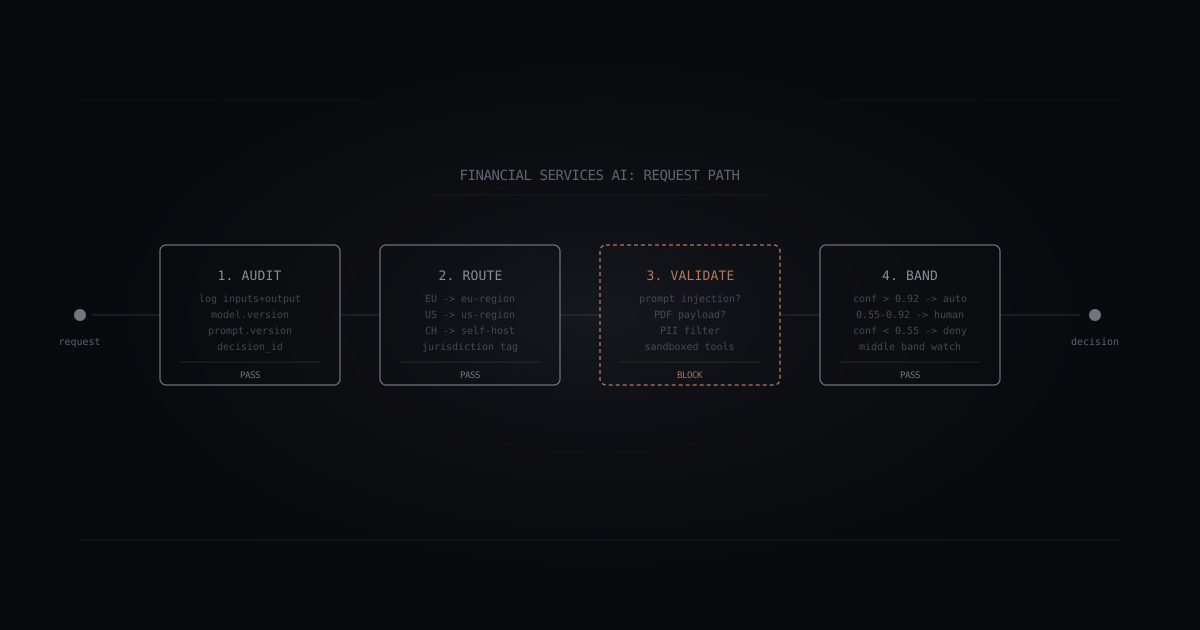
Operational consequence. You cannot ship a customer-facing AI tool that calls an LLM provider directly and logs nothing. Every inference call must produce a structured audit record: the exact inputs, the model identifier and version, the prompt version, any retrieved context injected, and the raw output before post-processing. That record must be queryable by decision ID and durable for the regulatory retention period. If a regulator asks you to reproduce a specific decision made 18 months ago, the answer must be in the store.
The anti-pattern. Teams log prompts for debugging but not outputs. They store the question, not the answer, and have no record of what context was injected on a specific call. Half the audit trail is present. The half that regulators ask for is missing.
Signal to implement. A decision_id that is immutable and follows the entire request chain. Log inputs, retrieved context, model version, prompt version, and raw output atomically per call. Verify completeness with a daily count of calls that produced no corresponding audit record.
Constraint 2: Data residency and sovereignty
Customer data in financial services is frequently subject to jurisdiction-specific rules that prohibit or constrain its transfer across borders. The General Data Protection Regulation restricts transfers of EU personal data to third countries without adequate safeguards. Banking secrecy laws in Switzerland, Singapore, and Hong Kong impose strict controls on where customer financial data can be processed. The US Office of the Comptroller of the Currency’s third-party risk guidance requires banks to assess and manage data risks introduced by vendor relationships, including cloud AI providers.
Operational consequence. You cannot use a single US-hosted SaaS LLM endpoint for all requests if any portion of your user base is EU-domiciled. The practical implication is a routing layer. Requests are classified by data sensitivity and customer jurisdiction at the gateway and routed to the appropriate model endpoint: an EU-region deployment, a self-hosted model, or a provider with adequate contractual isolation.
The routing logic becomes a compliance artifact, not just a performance concern.
The anti-pattern. It is rarely “we have one endpoint for everything.” It is usually a fallback path. EU traffic correctly routes to an EU endpoint 99% of the time. On EU-endpoint failure, a circuit breaker silently falls back to a US endpoint to keep the feature available. The fallback is the violation. The architecture has a healthy day shape and a non-compliant outage shape.
Signal to implement. Tag every inference request with a jurisdiction label at the gateway. Alert on any request without a label. Periodically verify that EU-labeled requests hit EU-region endpoints and do not fall through to a default US-hosted fallback.
Constraint 3: Adversarial input
Financial services is a high-value target. Attackers are motivated, technically capable, and actively probing AI systems for exploitable weaknesses. The threat surface is wider than most teams model for.
Prompt injection through customer-facing chatbots is the most visible vector. A claims-processing workflow that accepts PDF uploads is a document-injection surface: a malicious claimant can embed adversarial instructions in a submitted document that cause the model to misclassify the claim. Fraud-detection models face evasion attacks from adversaries who understand enough about the decision boundary to craft inputs that cross it. Production models can also be subject to model-extraction attacks, where a sophisticated adversary queries the system systematically to reconstruct its behavior.
Operational consequence. Input validation is a first-class architectural concern, not a security review at the end of the build. All inputs to any model that touches a financial decision must pass through a validation layer before reaching the model. Tool execution must be sandboxed. Output must be filtered for PII and sensitive information before being returned. Red-team testing is a release-gate requirement, not an optional audit.
The anti-pattern. Security review happens at the end of the build cycle. The prototype treats the LLM endpoint as a trusted internal service. Nobody has tried to inject adversarial instructions through a document upload, because the upload path was added in week three and security was on the agenda for week eight.
Signal to implement. A prompt-injection detection layer on all external inputs, with a hit-rate metric tracked per surface. Anomaly detection on output length and content type catches a class of injection responses before they reach the user.
Constraint 4: Long-tail risk asymmetry
Accuracy statistics do not transfer cleanly to financial services. A model that is correct 99% of the time is excellent in most applications. In financial services, the question is what happens in the other 1%.
If the 1% includes “approves a fraudulent wire transfer,” “denies a valid mortgage application based on a misread of credit history,” or “generates a trade recommendation that violates a client’s stated risk profile,” the 1% is not a rounding error. Regulatory penalties, litigation, reputational damage, and direct financial loss can dwarf the operational value the model delivered in the 99%.
Operational consequence. Human-in-the-loop is not optional for high-impact decisions. The standard production design pattern is a three-band decision system. Requests that exceed a high-confidence threshold are auto-processed. Requests that fall below a low-confidence threshold are auto-declined or auto-escalated. Requests in the middle band route to a human reviewer. Threshold boundaries are not arbitrary. They are calibrated against the cost of a false positive versus a false negative for each decision type, and reviewed on a schedule.
The anti-pattern. Binary automation. The model either handles the request or it does not. No confidence scoring. No middle band. Edge cases reach the automated path because the system has no mechanism to distinguish high-confidence decisions from borderline ones.
Signal to implement. A per-decision confidence score, tracked as a distribution over time. Alert when the middle-band volume increases, which signals distribution shift. Track human-reviewer outcomes against the model’s predictions to calibrate the band boundaries against real-world accuracy.
Where to start
The four constraints compound in a predictable order. Most teams discover them in the wrong order, during an audit or a compliance review, which is the most expensive discovery path. The right starting sequence works in the opposite direction.
- Instrument first. Before any model touches a production decision, define what a complete audit record looks like for your regulatory context. Build the telemetry layer and verify it before you enable the feature. The four-layer telemetry stack is the implementation foundation. Auditability is the strictest version of Layer 1 plus Layer 2 with no shortcuts allowed.
- Classify data at the gateway. Route by jurisdiction before routing for performance. Add jurisdiction labels in the same sprint as the first external API integration, not the sixth.
- Red-team before release. Run adversarial input tests against every customer-facing surface as a release gate. Treat document-upload paths and tool-call surfaces as separate test targets, not subsets of the chatbot test.
- Define decision bands before you automate. Know the high-confidence and low-confidence thresholds, and the human-review path, before the auto-decisioning logic goes live. Confidence calibration is a feature, not an audit response.
The rebuild took longer than the original build. That is the line teams remember six months in. What AI implementation actually costs in 2026 quantifies why constraint-driven rebuilds tend to recapitulate the full original cost plus migration overhead.
The takeaway
Financial services AI is not generic AI plus compliance review. It is a different architecture, and the four constraints are the design inputs.
Related reading
- What to instrument when your AI degrades in production. The four-layer telemetry stack that the auditability constraint depends on. Build this first; the regulator-readable audit record is a strict superset of what every production AI system should already log.
- AI implementation costs in 2026: what companies actually spend. The rebuild dynamic from the composite story, in quantitative terms. Cost numbers shift the conversation from “should we instrument up front” to “we cannot afford not to.”
Zylver ships AI products: Forge, Signal, Agents, Flows, and Meter. View all products.
More from Zylver
What your board needs to know about AI
Boards are being asked to provide oversight on AI at a moment when most board members lack the background to evaluate what they are hearing. The gap between what boards need to know and what they typically get in management presentations is real and consequential.
How AI is changing customer service
Customer service is one of the business functions most visibly transformed by AI. The changes are happening faster than most organizations planned for, and the outcomes depend heavily on implementation decisions that are easy to get wrong.
How to scale AI adoption from one team to the whole organization
Getting AI to work in one team is a different challenge from scaling it across an organization. What worked for the first team often fails when applied elsewhere, and the failure mode is usually invisible until the expansion is already stalled.
Get insights like this delivered monthly.
No spam. Unsubscribe anytime.