Multi-tenant AI: what you can't fake when you have 50 customers
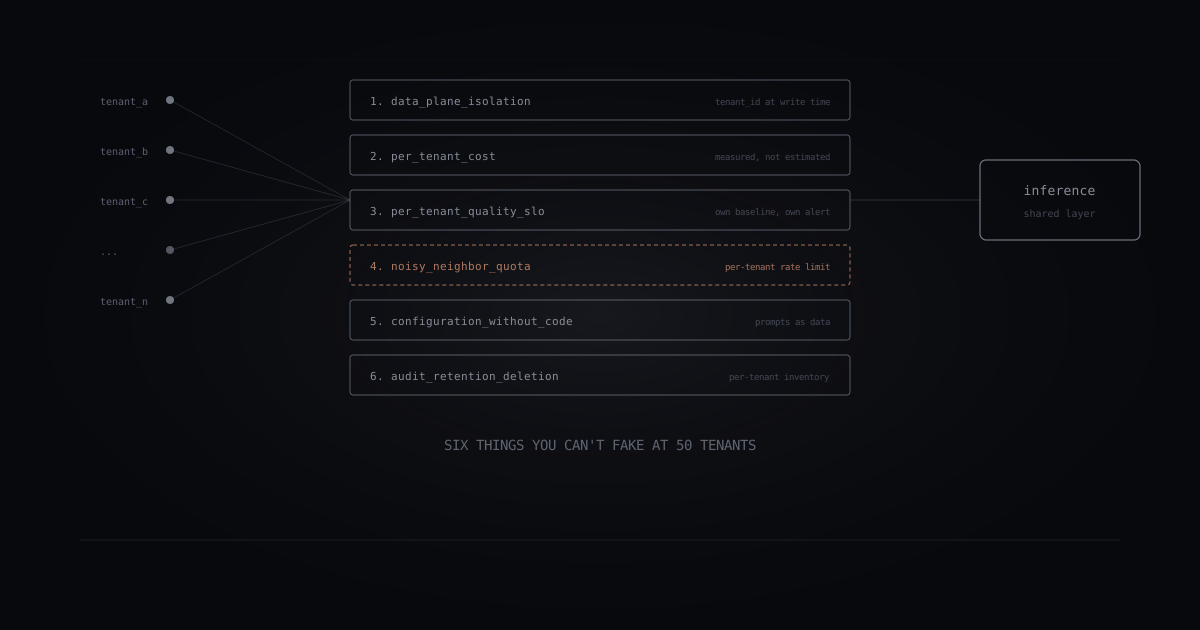
Single-tenant AI hides bad architecture. Multi-tenant AI exposes it. Six things that compound across a tenant set and cannot be deferred.
By Ramiro Enriquez
A SaaS team we know started with three design partners. The product was novel enough that they did not want to over-engineer the foundation before they understood what customers actually needed. That was the right call. The architecture was “good enough for three”: one shared infrastructure environment, prompts in application code, aggregate cost tracking, a single quality dashboard.
They did not revisit the architecture at customer 10. Or 15. Each new customer was manageable. A new config file. A new row in the accounts table. Custom prompts merged into the codebase. The onboarding checklist was eight steps, taking two engineering hours per customer.
At 25, every onboarding required a code change. The prompts had diverged enough that merging a new tenant required conflict resolution. They started talking about a configuration layer and never had the sprint capacity to build it.
At 40, on-call was firefighting noisy-neighbor incidents weekly. One tenant had irregular usage spikes that saturated the shared worker pool for 15 to 20 minutes at a time. Manual rate-limit overrides kept the lights on. The overrides required engineering. Support tickets always arrived first.
At 50, they paused new sales for 90 days to rearchitect.
The thing that broke first, at customer 38, was cost attribution.
One tenant’s usage was 11 times the median. The per-seat contract had no relationship to per-seat inference cost. The team could not quantify the discrepancy precisely enough to renegotiate, because they had no per-tenant cost data. They had total monthly spend and a seat count. The seat count was not the unit of cost.
This is the default trajectory for AI platforms that grow tenant-by-tenant without revisiting the foundation. The architectural debt is invisible at low tenant counts and unavoidable at high ones.
Why multi-tenant breaks single-tenant patterns
Single-tenant AI is forgiving. With one customer, every architectural shortcut stays local. Bad isolation is somebody else’s problem. No cost attribution? You have one invoice. Quality regression? You have one support line to watch. The single tenant is both the signal and the noise. You can fix things per customer because there is only one.
Multi-tenant AI is a different discipline. The moment you add a second tenant, every decision you deferred starts to compound across the tenant set. A shared embedding space that was “fine for now” with one customer is a cross-contamination risk with ten and an audit liability with fifty. Per-seat pricing that worked for three design partners becomes a structural mismatch the day one tenant’s usage is ten times another’s.
The failure mode is not dramatic. It is gradual. Teams add tenants on top of a single-tenant architecture because each onboarding looks manageable in isolation. The problems are invisible per tenant and inescapable in aggregate.
Six things compound at scale and cannot be retrofitted cheaply. None of them get easier to add after the fact. All of them are detectable before you start.
1. Data-plane isolation
What it is. Every prompt, embedding, retrieval, and cache operation must carry a tenant identifier at the lowest level of storage. Not as an application-layer filter applied after retrieval. As a structural property of the data itself. Tenant data must never cross-contaminate, including in shared embedding spaces, where neighbor proximity can bridge tenants without any direct data access.
The operational consequence. In retrieval-augmented generation systems, the retrieval step is where isolation is easiest to lose. A shared vector index filtered by tenant ID at query time has a much weaker isolation guarantee than one where each tenant’s embeddings are physically partitioned. The filter can be bypassed by reranking logic, similarity scoring at a level below the filter, or a simple implementation bug. Physical partitioning cannot.
The anti-pattern. Application-layer filtering: one vector store, one embedding space, tenant ID passed as a metadata filter on every query. This is the most common architecture, because it is the fastest to build. It works at one tenant. It works at ten. At 50, it is one filter bug away from a cross-tenant data leak that you will report to every customer in writing.
The control to implement. Tenant ID is a write-time property, not a read-time parameter. It is set when data is ingested, not when it is queried. Your retrieval layer should be able to enforce that no retrieval can return results outside the caller’s tenant ID before any similarity scoring is applied. Log every retrieval with tenant ID. Alert on any cross-tenant hit, even one that was blocked.
2. Per-tenant cost attribution
What it is. Every operation has a cost. That cost must be attributable to a specific tenant at the call level, aggregable to any time window, and auditable after the fact. Not estimated from usage proxies. Measured from the inference event itself.
The operational consequence. Month-end billing is not the risk. The risk is discovering at month-end that one tenant consumed 60% of inference spend on a contract that was flat per seat. You cannot bill them, because the contract did not contemplate it. You cannot renegotiate, because you have no data to show them. You cannot reprice your other customers, because you do not know whose usage model the pricing was actually built on.
The anti-pattern. Aggregate cost tracking: one line item per provider, total tokens per billing period, no per-tenant breakdown. This architecture forces you to infer per-tenant cost from usage proxies (seats, requests, features used) rather than measuring it. The inferences are always wrong, often by an order of magnitude.
The control to implement. Every LLM call emits a structured cost event with tenant ID, operation type, model identifier, input and output tokens, computed cost, timestamp, and trace ID. These events are the source of record for billing. Pricing tiers and contracts are written against this data, not against seat counts. The four-layer telemetry stack covers Layer 1 in full. Apply it with tenant ID as a mandatory, non-nullable field from day one. Backfilling tenant ID into a year of cost events is materially harder than emitting it at write time.
3. Per-tenant quality SLOs
What it is. Quality SLOs must be defined, measured, and alerted on per tenant. Aggregate quality metrics are not a proxy for per-tenant quality. A platform average of 90% accuracy is consistent with one tenant at 99% and another at 71% in the same product.
The operational consequence. Quality degradation is the failure mode that aggregation hides best. A tenant whose retrieval index has gone stale, whose model is pinned to a deprecated endpoint, or whose golden-set score has been declining for six weeks will not appear in an aggregate dashboard until the degradation is severe enough to drag the platform average. By that point, the tenant’s support tickets have been open for weeks and the relationship is already strained.
The anti-pattern. Platform-wide quality dashboards: one golden-set score, one groundedness metric, one latency distribution. The dashboard is green while individual tenants silently fail.
The aggregate smooths the signal you most need to see.
The control to implement. Each tenant has its own golden set, scoped to their input distribution. Each runs its own scheduled replay. Each has its own alert threshold against its own seven-day rolling baseline, not against the platform average. A tenant whose score drops more than 10 points from its own baseline triggers an alert independent of platform performance. The platform average is a reporting metric. The per-tenant baseline is the operational signal.
4. Noisy-neighbor protection
What it is. One tenant’s traffic spike cannot degrade the capacity available to other tenants. This applies at two levels: upstream, at the LLM provider’s rate limits, and internally, at queue depth, worker capacity, and inference routing.
The operational consequence. A tenant launches an outbound campaign, a scheduled batch job, or a promotional event. Their request volume spikes tenfold in 30 minutes. Your platform hits provider rate limits. Every other tenant’s request queue backs up. Your largest customer notices first. This is not a hypothetical. By the time a platform has a few dozen tenants, the probability that at least one has a spiky traffic pattern in any given week approaches one. This is the dominant incident class we see at that scale.
The anti-pattern. Shared request pools with no per-tenant quotas. One queue, one worker pool, first-come-first-served. This is correct for single-tenant. In multi-tenant, it is a mechanism for one tenant’s traffic pattern to become everyone else’s incident.
The control to implement. Per-tenant rate limits at ingress: a token bucket per tenant on requests-per-minute and tokens-per-minute. Provider-side rate limits distributed across tenants in proportion to committed capacity, not instantaneous demand. Burst allowances written into contracts. When a tenant exceeds their burst, requests queue behind a per-tenant depth limit rather than consuming shared capacity. Alert on per-tenant queue depth, not just aggregate.
5. Configuration without code
What it is. Tenants need their own prompts, model routing, knowledge bases, guardrails, and branding. All of it must be configurable without a code change. If onboarding a new tenant requires a pull request, engineering is the bottleneck for sales.
The operational consequence. At three design partners, per-tenant code changes feel like normal software development. At ten, the onboarding backlog grows faster than the team can clear it. At 30, customer timelines are set by engineering availability, not sales velocity. At 50, the team faces a binary choice: pause sales and rearchitect, or keep selling and ship each customer as a code fork. Both outcomes are survivable. Neither is in the original business plan.
The anti-pattern. Prompts, model identifiers, knowledge-base paths, and guardrail configurations stored directly in code or hardcoded in deployment manifests. Each onboarding is a commit. The repository becomes a mix of product code and tenant data. The two evolve at different rates and for different reasons. Git history stops being useful for either.
The control to implement. A tenant configuration layer that is entirely separate from application code. Tenant records live in a data store, not a repository. Prompts are versioned artifacts with their own identity, not inline strings. Model selection, knowledge-base routing, guardrail policy, and output branding are tenant attributes the platform reads at runtime. Zylver Forge builds on this separation: typed configuration contracts that agents declare and the platform enforces at dispatch. Whatever you build it on, the boundary is the same. Configuration leaves the codebase, or onboarding stays in engineering.
6. Tenant-scoped audit, retention, and deletion
What it is. Each tenant’s data has its own retention schedule, residency requirements, and right-to-deletion obligations. These are properties of every object the platform stores: embeddings, cache entries, audit logs, traces forwarded to third-party observability infrastructure.
The operational consequence. A tenant submits a deletion request. Your application table is easy: delete the row. Your vector store is harder: you need to find every embedding that contains that tenant’s data, which requires tenant-scoped index operations you may not have built. Your audit log is harder still: some regulatory frameworks require you to retain audit events for a period after deletion of the underlying data, which means your audit system must describe what happened without retaining what it happened to. Provider-side observability data is hardest of all, if any payloads were forwarded to a third-party platform with its own retention policy.
The anti-pattern. A single shared audit log, a vector store with no tenant-scoped deletion path, and no inventory of where tenant data has been written. Deletion becomes a multi-week investigation because the team does not know what to delete or where it lives.
The control to implement. A data inventory per tenant. Every store that holds their data. The retention schedule for each. The deletion procedure for each. Audit events carry tenant ID as an indexed, immutable field. Vector-store deletion is a first-class operation, not a workaround. Provider data-sharing agreements are reviewed at onboarding against each tenant’s residency requirements. The audit-first instrumentation needed for regulated tenants is the strict version of this control. The lighter version applies to all tenants.
Where to start tomorrow
The right entry point is whatever gets harder to retrofit fastest. That points to data-plane isolation and cost attribution. Both require migrating existing data, not just changing behavior for new writes. Defer them and the migration grows with every new tenant.
- Audit your retrieval layer this week. Can a query return results from a tenant other than the caller? If the answer requires code inspection rather than infrastructure inspection, your isolation is application-layer, not data-plane. Decide whether that is acceptable for your current tenant count and know the line you are drawing.
- Add tenant ID to every cost event today. If you are emitting Layer 1 telemetry per the four-layer stack, make tenant ID a mandatory, non-nullable field. If you are not emitting Layer 1 telemetry yet, start there. Per-tenant cost attribution is a free byproduct of doing Layer 1 right.
- Map where tenant data lives. Before you have a deletion request, produce the inventory. Every store, every index, every cache, every provider integration. The map does not need to be perfect. It needs to exist.
The other three items (quality SLOs, noisy-neighbor protection, configuration without code) are equally important and easier to add later. These three are load-bearing under everything else.
The takeaway
Single-tenant AI lets you defer architectural decisions. Multi-tenant AI returns them as bills, deletion requests, and outage tickets. Pay them up front.
Related reading
- What to instrument when your AI degrades in production. The telemetry stack that makes per-tenant cost, quality, and audit possible. Apply each layer with tenant ID as a mandatory field; everything else in this post becomes available as a byproduct.
- Why your AI gets more expensive over time (and how to reverse it). What to do with the per-tenant cost data once you have it. Distillation, model routing, and prompt compression compound especially well across a tenant set.
Zylver ships AI products: Forge, Signal, Agents, Flows, and Meter. View all products.
More from Zylver
What your board needs to know about AI
Boards are being asked to provide oversight on AI at a moment when most board members lack the background to evaluate what they are hearing. The gap between what boards need to know and what they typically get in management presentations is real and consequential.
How AI is changing customer service
Customer service is one of the business functions most visibly transformed by AI. The changes are happening faster than most organizations planned for, and the outcomes depend heavily on implementation decisions that are easy to get wrong.
How to scale AI adoption from one team to the whole organization
Getting AI to work in one team is a different challenge from scaling it across an organization. What worked for the first team often fails when applied elsewhere, and the failure mode is usually invisible until the expansion is already stalled.
Get insights like this delivered monthly.
No spam. Unsubscribe anytime.