RAG vs fine-tuning: why the comparison mostly doesn't make sense
RAG and fine-tuning solve different problems: knowledge boundaries versus behavior. Treating them as interchangeable wastes months of engineering.
By Ramiro Enriquez
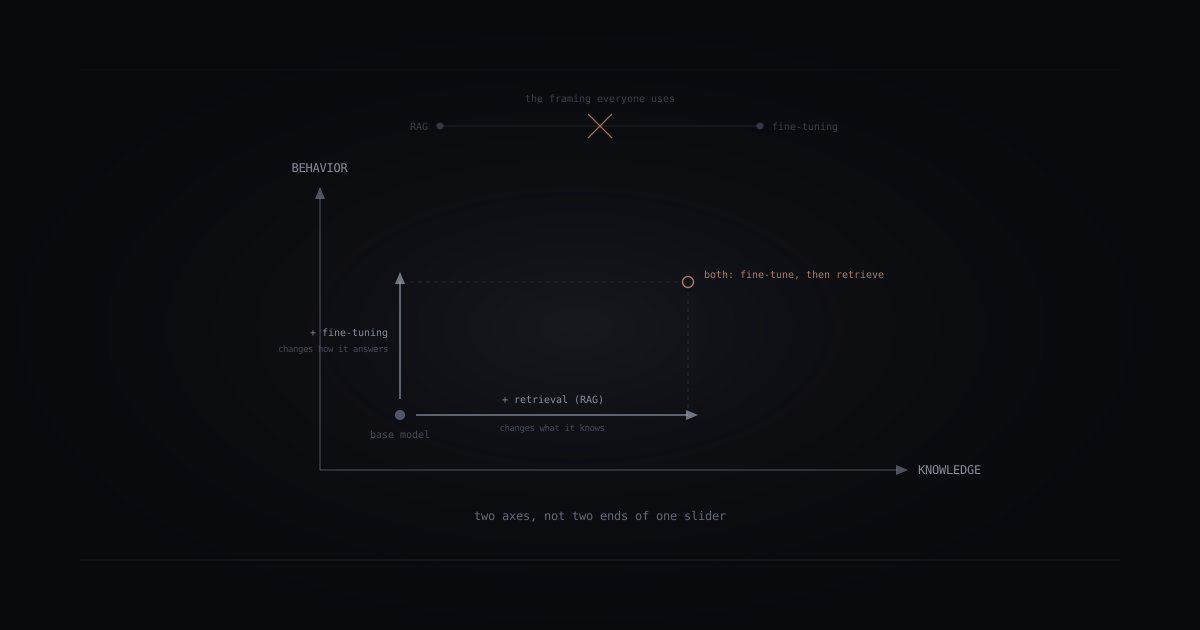
Every week someone posts a benchmark comparing RAG versus fine-tuning on some task, usually framed as a cost-quality tradeoff. Fine-tuning wins on latency. RAG wins on freshness. One costs more upfront, the other costs more per call. The comparison feels useful, but it misses the thing that matters most: they solve different problems.
Treating RAG and fine-tuning as alternatives for the same job is the most common way to waste six months on an AI infrastructure project.
What problem each one actually solves
RAG solves the knowledge boundary problem. A language model knows what it knew at training time. If your task requires information that is newer than the training cutoff, private to your organization, or too specific to be well-represented in public training data, the model does not have it. RAG addresses this by retrieving relevant documents at inference time and placing them in the model’s context. The model does not need to have memorized the information; it just needs to be able to use it when it is presented.
Fine-tuning solves the behavior problem. A base model behaves a certain way: it has a default tone, a default format, a default set of assumptions about what a response should look like. If your task requires a different set of behaviors (a different voice, a different output structure, a different set of priorities), fine-tuning is how you adjust those behaviors by training on examples that demonstrate what you want.
The simplest way to tell them apart: if the model would give the right answer if you put the right information in the prompt, you have a knowledge boundary problem and RAG is the tool. If the model gives wrong answers even when you give it all the information, you have a behavior problem and fine-tuning is the tool.
Where teams get this wrong
The most common mistake is using fine-tuning to solve a knowledge boundary problem. A team wants the model to know about their internal processes, their products, their customers. They collect training examples, fine-tune a model, and deploy it. For a few weeks, it works. Then the information changes. Now they need to fine-tune again. The maintenance cost is ongoing, the model is always slightly out of date, and the cost of updating grows with every new fine-tuning run.
The correct solution was RAG: store the internal knowledge in a retrieval system, retrieve it at inference time, let the model use current information on every call. Fine-tuning was solving the wrong problem.
The second common mistake is using RAG to solve a behavior problem. A team wants the model to output a specific JSON format, follow a specific reasoning pattern, or adopt a specific persona. They add detailed instructions to the retrieval context, hoping that adding more information will shape the output. It does not work well because the problem is not information; it is behavior. The model will still default to its trained patterns unless those patterns are changed.
The correct solution was fine-tuning (or strong system prompt engineering): change the model’s default behavior rather than trying to override it with retrieved content on every call.
Cases where both are relevant
Some tasks genuinely need both: they require current, specific knowledge AND a behavior that differs from the base model’s default.
A legal research assistant that answers questions about specific case law needs RAG (the case law is too voluminous and changes too often to bake into training) and might benefit from fine-tuning (legal response formats and citation styles differ from the model’s defaults). A customer support bot needs RAG for product-specific information and might benefit from fine-tuning to match the brand’s tone.
When both are relevant, the implementation order matters. Fine-tune first on behavior, then layer RAG on top for knowledge. Fine-tuning on a model that has access to specific retrieved context tends to produce more reliable behavior than the reverse.
A decision framework that holds
Before spending time on either approach, answer these questions:
Would the model give the right answer if you included the relevant information in the prompt?
If yes: knowledge boundary problem. Use RAG. If your knowledge base is small enough to fit in a context window, try naive retrieval first before investing in vector search infrastructure. Chunking strategy, metadata filtering, and re-ranking matter more than most teams expect.
If no: behavior problem. Investigate whether system prompts and few-shot examples in the prompt can close the gap before moving to fine-tuning. Fine-tuning is expensive to iterate on and requires good training data. If you do not have 500+ high-quality examples of the behavior you want, you probably cannot fine-tune effectively yet.
How often does the relevant information change?
If the information changes frequently (more than monthly), fine-tuning is almost always the wrong tool. The maintenance overhead of keeping a fine-tuned model current with changing facts is higher than most teams anticipate. RAG with a retrieval layer that can be updated without retraining is the right architecture.
Does the model’s default behavior already produce acceptable outputs when given good information?
If yes: you probably only need RAG. The retrieval quality, chunking, and metadata strategy matter more than the model’s parameters in this case.
If no: investigate whether few-shot examples in the prompt can bridge the gap. If the required behavior is consistent enough that you can describe it with examples, few-shot prompting is faster to iterate on than fine-tuning and often close enough in quality.
The latency argument
Fine-tuning is sometimes recommended for latency reasons: a fine-tuned model can produce correct outputs without retrieval overhead. This is a valid consideration but usually not the deciding factor.
RAG latency is dominated by retrieval time, not by model inference time. A well-optimized retrieval pipeline typically adds 50-200ms. If that is unacceptable for your use case, a fine-tuned model can eliminate the retrieval step. But before paying the fine-tuning cost, check whether your RAG retrieval is actually the bottleneck.
Most latency problems in RAG pipelines are retrieval infrastructure problems, not fundamental limitations of the approach. Parallel retrieval, caching popular queries, and reducing chunk size can often address latency without changing the model.
What to do first
If you are starting a new AI feature and wondering which approach to use: start with prompt engineering and a retrieval layer. This is almost always the right first step because it is fast to iterate, easy to update, and works well for the large majority of tasks that have a knowledge boundary component.
Move to fine-tuning when you have a clear behavior problem that prompt engineering cannot solve, when you have high-quality examples of the target behavior, and when the behavior you need is consistent enough to be represented in training data.
The teams that spend six months on the wrong approach usually made a decision early, before they had enough data about which problem they actually had. The fastest path to finding out is to try the simpler thing first: RAG with a good retrieval strategy. If the model gives good answers when the right information is in context, you are done. If it does not, you have learned something important about what kind of problem you are actually solving.
Zylver ships AI products: Forge, Signal, Agents, Flows, and Meter. View all products.
More from Zylver
How to make the business case for AI investment
Most AI investment proposals fail not because the technology does not work, but because the proposal is framed around capability rather than outcome. Here is how to build a case that finance and leadership will approve.
The AI vendor landscape is consolidating: what it means for buyers
The number of credible AI infrastructure vendors is shrinking. For enterprise buyers, that changes the procurement calculus in ways that are not yet reflected in most vendor evaluation frameworks.
How to structure an AI team
There is no single correct structure for an AI team. There are structures that work for specific organizational contexts and ones that create predictable failure modes. Here is how to tell the difference.
Get insights like this delivered monthly.
No spam. Unsubscribe anytime.